By Emma Eyers
As we approach the end of this NIHR Applied Research Collaboration Yorkshire and Humber (YHARC) funding round, there is much to be proud of. Over the past 5 years our team, partners and communities have worked tirelessly to ensure that we have chosen research topics that are needed, and that our research doesn’t just sit on shelves but makes a real difference to people’s lives. It is the perfect moment to pause, reflect and celebrate what we have achieved together. Here are some of the highlights from our most recent work, and a glimpse of the legacy that the team leaves behind.
Benefits for healthcare staff of involvement in applied health research.
Taking part in research can be beneficial for healthcare staff. Dr Andria Hanbury (Theme Manager), working with colleagues from other ARCs, led a review of 49 UK studies (2003–2023) and found evidence that involvement in applied health research leads to six key benefits: personal fulfilment, skill development, stronger professional networks, ongoing learning, improved clinical practice, and more evidence-based decision-making.
Clinical-academic staff were more likely to report practice improvements and peer support, while others emphasised learning and confidence. Interestingly, even staff with ‘light-touch’ involvement, such as involvement in training or data collection, reported higher job satisfaction and professional growth when engaging with research. Perhaps more importantly however, supporting research participation can enhance workforce development, retention, and care quality. This research has recently gained national reach, with the publication having been shared and promoted at an NIHR Strategy and Engagement Board meeting attended by NIHR programme leads and infrastructure network leads as well as senior department of health and social care colleagues. Here is the link to the project page, which links to the published paper and provides resources to support dissemination, including a short video and brief summaries for NHS managers and wellbeing leads: https://arc-yh.nihr.ac.uk/research/projects/healthcare-staff-involvement-with-applied-health-research-what-are-the-benefits-arc-national-implementation-improvement-science-themes-network/
Health and social care staff wellbeing and retention

This leads me to think about another thread running through recent YHARC work around staff wellbeing, professional development, and recognising the growing tension of recruitment and retention into the UK health and social care sector. This sector is facing a profound wellbeing and retention crisis: almost 30% of all sick-days in social care are reportedly due to mental health, stress or other work-related strain. Behind these statistics is an exhausted workforce coping with working with burnout, increased stress and unsustainable pressures that continue to drive over 100,000 NHS workers to leave the sector each year. This threatens not just retention but the very wellbeing of the workforce that underpins UK healthcare.
The Improvement Science team, and partners across the sector including health and social care professionals are currently working on a study to identify and gain consensus on which factors in health and social care employment in the UK are most likely to predict staff wellbeing and what outcomes associated with wellbeing are most important to assess. To do this, we carried out an umbrella review of existing evidence. Thirty-eight factors were identified in areas such as workplace culture and how staff are treated; how work is organised and communicated; contractual and practical issues; and the physical environment of work, along with nine outcomes including staff retention, sickness and mental health.
Building on this review, the team is now working with health and social care professionals, managers, and researchers to agree which of these factors is most important for staff wellbeing. This is being done through a Delphi study, an approach that uses multiple rounds of questionnaires to reach consensus on a topic. The input of those working across health and social care services will help shape a staff wellbeing outcome and predictor set which we hope will support employers, policymakers, and workforce leaders in their efforts to promote and measure staff health, satisfaction, and retention. The findings are expected in spring 2026.
Implementation laboratory
The Implementation Laboratory suite of work led by Professor Robbie Foy and Dr Sarah Alderson is an ongoing collaboration with our regional ICBs. The aim is to stimulate improvement in priority areas through evidence-based audit and feedback campaigns. One such campaign has been the Lowering Anti-Microbial Prescribing (LAMP) campaign, through which general practices in the region have received electronic bimonthly feedback reports. Running for over five years, it has reached over 500 general practices across the region, covering over 4 million people, with antibiotic prescribing in West Yorkshire falling by 24% in this period. Professor Foy was nominated for a prestigious NIHR impact Prize for this work. The team have also shared their findings and insights with several national clinical audit programmes through presentations and advisory roles and secured further funding during the time of the ARC to:
- Evaluate the impact of audit and feedback on prescribing health inequalities: Impact of an Intervention on Inequalities in Overprescribing – the 3i-o study – NIHR Funding and Awards
- Evaluate initiatives linked to the National Diabetes Audit to improve diabetes care through two separate large grants, the protocol paper for the first can be accessed here: A cluster randomised controlled trial, process and economic evaluation of quality improvement collaboratives aligned to a national audit to improve the care for people with diabetes (EQUIPD): study protocol | Implementation Science | Full Text
Professor Robbie Foy, and Dr Sarah Alderson also delivered a pilot Implementation Science Research course in May 2024. This brought together early and mid-career researchers to strengthen their skills in developing and evaluating strategies for embedding evidence-based practice in healthcare. Over three days, experts led sessions on designing and testing implementation strategies, advanced trial and evaluation methods, and securing and sharing research. With a blend of lectures, group exercises, and shared case studies, the course combined real-world insights with cutting-edge research and was jointly supported by LUCID and YHARC. Robbie and Sarah hope to roll the course out in 2026, and so if you are looking to improve your knowledge of implementation research, watch out for more news on this in early 2026.
Learning more about improvement science: snapshot series
Mobilising knowledge in ways that are catchy, personable and accessible, plays a big part in what we do. As part of our commitment to capacity building, and in addition to the many projects being carried out, YHARC invested in creating a series of short, accessible training videos to support anyone interested in improvement science. These videos showcase some of the most useful tools in health research and quality improvement and encourage researchers to try out new methods.
The Improvement Science Snapshot Series has received over 6000 views and covered topics such as rapid ethnographic methods to explore ward culture, rapid qualitative methods for quick insights, de-implementation of low-value care, and designing logic models that reflect real-world complexity. Viewers can also find practical advice on audit and feedback by Professor Robbie Foy and Dr Sarah Alderson (including 10 easy tips), the Positive Deviance approach, Normalisation Process Theory, and co-production in health research. The series also introduces the implementation outcome repository, video reflexive ethnography for maternity care, and behaviour change techniques. By creating these snapshots, the team make complex ideas approachable and show how they can be applied to improve health and care in practice, all in 7 minutes or less!
Avoidable transfers and improvements in resident care
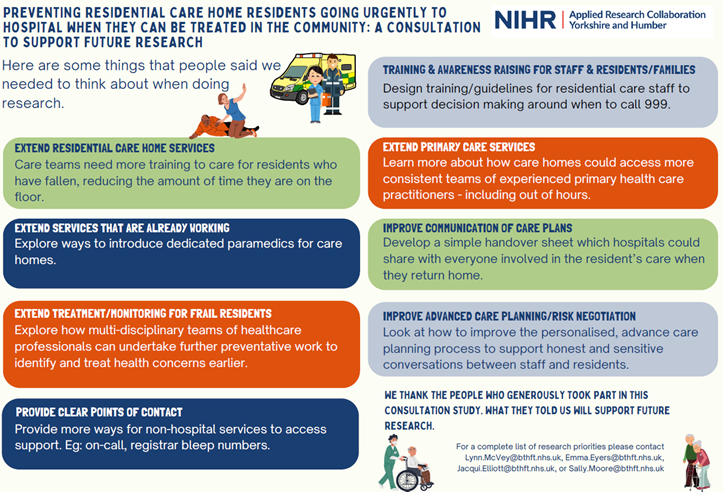
A project close to my own heart, as I have background working in social care settings, is the avoidable transfers project. Led by Dr Lynn McVey (SRF, Improvement Science), Dr Andria Hanbury, and supported by myself with oversight from Professor Rebecca Lawton (Theme Lead), this work involved talking to staff, care home residents, their families and staff, GPs, paramedics, and other workers across hospital and community care. Staff told us that these transfers happen because they don’t have timely access to residents’ medical histories or care plans, or they feel there is no safe alternative in the moment of need. Families described how upsetting and disorientating a hospital visit can be for their loved one, especially late at night or when they could have been cared for at home.
Working together with stakeholders, our team developed some practical recommendations for future research: clear shared care plans, better communication between GP’s, care homes and ambulance services, more use of telemedicine support for quick reassurance, and training to help staff feel confident in managing situations on site. We are proud of this work, especially the feedback from care home residents who told us that they enjoyed being able to share their stories. We are also pleased to have shared our work with the wider research community. Our learning around best practice when engaging with care homes has played a key role in designing future projects.
The future of research: PhD studentships
Across all of the YHARC, PhD studentships are awarded to budding researchers for projects that are embedded in real-world problems. Our students aren’t distant academics: they collaborate with staff, co-design interventions and are considered part of the team. Here are a few examples of the kinds of work they do.
Martha Miles, a current PhD student, is working to address the problem that staff insights in maternity care are often missed. By carrying out a focused ethnographic study with maternity staff, Martha hopes to demonstrate how employee voice can be captured and used to improve patient safety.
Qandeel Shah’s PhD looked at low-value mental health care practices from the perspective of the people who use these services. This research marks an exciting step forward in shaping mental health care that truly reflects patient voices. By working directly with service users, Qandeel’s PhD uncovered four practices seen as low-value, highlighting enhanced observation as a key priority for change. Ethnographic research and stakeholder consultation not only revealed how ingrained these practices have become but also generated nine practical recommendations to reduce their inappropriate use.
Megan Smith recently submitted her PhD, comparing recommendations for how to improve smoking cessation support for people receiving mental health inpatient care between 1) those generated through a more ‘bottom up’ positive deviance approach and 2) those generated through a more ‘top down’ systematic review approach.
Shared Safety Net Action Plan (SSNAP) Feasibility study1
As a team, our work continues into the new year with projects that we care deeply about. Firstly, Dr Lynn McVey is leading on a feasibility study to test a new tool designed to make safety-netting clearer for patients with non-specific symptoms that could signal cancer. The SSNAP tool provides a summary of what to monitor, for how long, and when to return to the GP. It also helps practices follow up effectively.
Over the next 30 months, the team will test SSNAP in six general practices in Northern England, gathering feedback from patients, families, and staff, alongside usage and outcome data. Insights from this study will help shape a larger trial across England, with the goal of making safety-netting clearer, more effective, and more patient-centered.
Ambulance handover delays in urgent and emergency care
We are also working in collaboration with the UEC theme, to evaluate an innovation designed to address ambulance handover delays.
In 2024/25, ambulance handover delays in England reached a staggering 249,626 instances, with over 30% of ambulance arrivals experiencing delays of 30 minutes or more. These delays not only jeopardise patient safety but also result in significant system inefficiencies, including the loss of over 1.5 million ambulance hours, equivalent to 187 years, spent waiting outside emergency departments.
We are in the midst of an evaluation of an innovation designed to address this issue called the ‘withdraw at 45’ (W45) or ‘Rapid Release Protocol. This allows ambulance crews to leave the ED if patients are not accepted within 45 minutes, freeing ambulances for other emergencies. Using linked ambulance and hospital data, and qualitative insight into the experiences of implementing the W45, the project studies factors behind delays, patient outcomes, and implementation challenges.
Preliminary findings are expected in spring 2026. Here is an earlier blog on this project, written by our colleagues in the UEC theme: Are ambulance handover delays the new normal in urgent and emergency care? – ARC
The end of an era
This blog has highlighted just a few of the many projects, partnerships and innovations we’ve been privileged to be part of. Over the past 5 years, we have secured much funding, trained the next generation of researchers, and built lasting relationships with over 40 partner organisations. Most importantly, YHARC has showcased what is possible when research teams, health and social care practitioners, policy-makers and communities work together.
As we prepare to close this chapter, we want to say a huge thank you to all the researchers and delivery teams, public contributors, partner organisations, and the communities who have given their time and voices. We also want to thank our lay leaders who are relentless in their dedication to their communities and making our work matter. Our work for this period may be winding up, but the impact will continue to grow, and the influence of these people will carry on into the next ARC chapter.
- This study is funded by the National Institute for Health and Care Research (NIHR) [Research for Patient Benefit (NIHR208819)]. The views expressed are those of the author(s) and not necessarily those of the NIHR or the Department of Health and Social Care