By Chris Quinn (Co-applicant and Lay Member), Liz Graham (Co-applicant and Senior Research Fellow) and Lesley Brown (Study Lead)
The Hearing Loss in Later Life study is an NIHR Research for Patient Benefit (RfPB) funded study, using qualitative methods (interviews and workshops) to understand how older adults living with frailty can be better supported to manage their hearing loss (https://ageingstrokeresearch.org/research-projects/hearing-loss-in-later-life/).
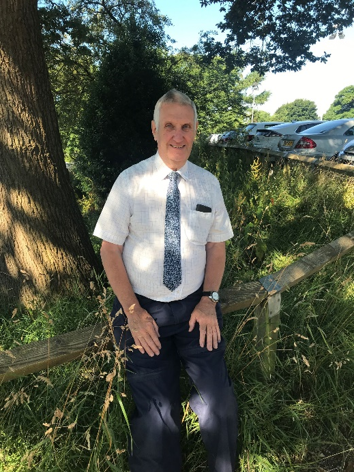
Chris Quinn, Co-applicant and Lay Member
Chris Quinn lives with hearing loss and is a study co-applicant. Here, he reflects on his own hearing loss journey and the impact it has had throughout his life.
‘For as long as I can remember, I spent much of my early life saying “Pardon?” to people trying to talk to me. I never thought of myself as deaf (although I made a pretty poor attempt at the hearing tests all primary school pupils took in those days) and had no explanation until my mid-twenties, when my GP told me I had no eardrum in my right ear. This became relevant as I regularly suffered severe bouts of tonsillitis, which came on suddenly and could leave me unable to work for up to a fortnight.
My GP referred me to a remarkable surgeon in the ENT department at BRI. She told me she could replace the eardrum. Amazed, I asked how. She explained that she would take a small piece of skin from below my right ear and sew it over the hole where the eardrum should have been. The procedure was fairly new, she said, and would require a two-week stay in hospital. That seemed a bargain, as it offered a good chance of eliminating, or at least greatly reducing, the tonsillitis. I asked whether it would restore my hearing. She admitted there might be a slight improvement, but the main aim was to prevent infection.
When I told my mum about the operation, she explained that I’d had a severe ear infection at the age of three, which had destroyed the eardrum. In those days there was no cure, so at last one mystery was solved. The two weeks in hospital were quite an experience, but I’d better not go into that here! The operation was a complete success, and I haven’t had tonsillitis since. However, the doctor was right: my hearing showed no measurable improvement!
I’d been married a few years and life was busy. My wife and I loved music and attended many concerts: the Halle Orchestra at St Georges Hall, Opera North in Halifax, and brass band performances wherever we could get tickets. These were the very early days of CDs, and we built up quite a collection. What I did notice was that I didn’t enjoy social gatherings very much. With only one functioning ear, it was difficult to work out who was talking to whom. This caused a little matrimonial friction, as my wife came from a large family who thrived on big gatherings, whereas I was much less enthusiastic.
By the time I reached my sixties, my wife was becoming rather fed up with my not hearing her and suspected it might be a case of not listening rather than not hearing. She also felt I was becoming irritable, which she attributed to my hearing difficulties.
Eventually I consulted my GP, and he referred me back to ENT at BRI. The consultant explained that eardrum replacement techniques had advanced considerably since my operation but doubted that further surgery would improve my hearing much. He arranged extensive hearing tests, which showed that the hearing in my left ear was also well below normal.
Soon afterwards I was fitted with a hearing aid in my left ear. I immediately realised that I spoke far too loudly, and unfortunately still do. Looking back, I also recognised that I had relied on lip reading, quite unconsciously, for many years. The clues had been there all along. I remember visiting a working mill one evening to explain that we needed to interrupt the water supply while repairs were carried out. The weaving shed was deafeningly noisy, yet I could understand the lady I was speaking to perfectly, while my colleague could not. I was lip reading without even thinking about it.
I’ve been retired for many years now and find the volume of background music in pubs and restaurants a real challenge, so I tend to avoid them. It may just be my perception, but people, especially youngsters, seem to speak much faster these days, which creates its own difficulties. My CD collection sits largely untouched, although I still enjoy the occasional brass band concert. Two of my grandchildren play with the Wantage Silver Band (in the Home Counties they silver-plate their brass instruments for some obscure reason!).
One of my other pleasures these days is cycling. I started when I was 8 years old and I’ve done it ever since. Here, my hearing aid is a mixed blessing as anything more than a gentle breeze generates so much noise that I can’t hear vehicles behind me. OK, I’ve fitted a mirror so that I can see what is going on behind, but hearing is an additional safeguard. On balance, I think I’m probably safer not wearing it when riding.
My family and friends have learned to manage my deafness by making sure I can see who is speaking, talking a little more slowly, and walking on my left side when we are out. It has taught me an important lesson: I try to adapt my own behaviour to other people’s needs rather than expecting them always to make the allowances.’
Chris’s first-hand experience of living with hearing loss is a real asset to the study, helping to ensure that explored topics are relevant and meaningful. Chris and other members of our PPI group have also taken part in practice interviews, allowing the researchers to refine their interview skills and their understanding of hearing loss.
The impact of hearing loss can be far-reaching and is often particularly challenging for older adults living with frailty, who may already be managing multiple health conditions. However, some of these challenges can be reduced with support, such as access to well-functioning, well-fitted hearing aids. Modern hearing aids often include useful features such as Bluetooth connectivity and built-in compatibility with hearing loop systems, helping people communicate more easily in everyday situations. Our study will identify how and where older adults living with frailty can best be supported to manage hearing loss and its effects, and to make the most of modern hearing-support technologies.
For further information about this study contact: Liz.Graham@bthft.nhs.uk