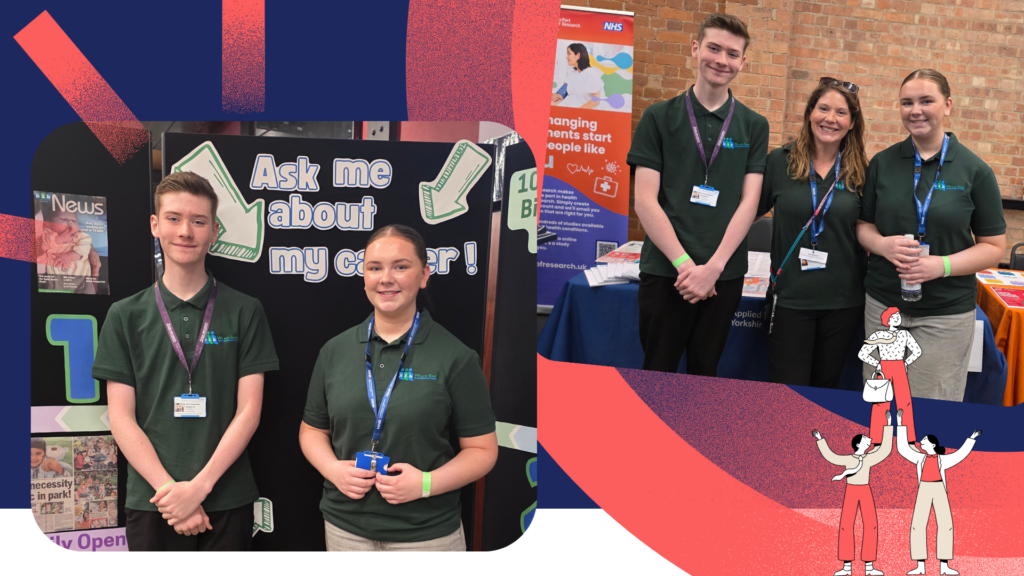
At NIHR ARC Yorkshire and Humber (YH ARC), our work involves translating applied health and care research into practice. As part of our commitment to developing research capacity, we recently partnered with the Bradford Institute for Health Research (BIHR) to host two Year 12 students, Daniel and Ceara, for an work experience placement.
During their time with us, the students experienced the full breadth of the NIHR infrastructure. They shadowed staff in the NIHR Commercial Research Delivery Centre (CRDC) and worked alongside research midwives to understand the realities of patient recruitment. They also spoke with YH ARC researchers to discuss the impact of applied health research, while engaging with teams across knowledge mobilisation, data analytics, and AI. Finally, they gained hands-on experience in public engagement by supporting the Born in Bradford Careers Fair.
Shifting Perspectives
The placement aimed to provide a practical look at what a career in research actually involves. Reflecting on his time with the team, Daniel noted: “Before this month I viewed research as being much more ‘focused’ when in reality, each study collects many different types of data from participants.”
Ceara noted how the experience connected her studies to real-world application: “It was fascinating to be able to see how the subjects I enjoy studying… are put into practice in real life to help patients.” She added: “Before doing this work experience, I imagined research to be predominantly in science labs away from patients, but this month made me realise that patients are absolutely critical to the success of research.”
Advice for Future Students
When asked what advice they would give to students joining us for future placements, both Daniel and Ceara emphasised the importance of curiosity.
Daniel suggested: “Take as many chances as possible to ask questions and to learn as much about the world of research as possible.” Ceara added: “Everyone is super friendly and welcoming; no question is silly.”
We are grateful to our Communications and CRDC teams for supporting the students. By providing these opportunities, we hope to support the next generation of researchers in understanding how evidence is applied in health and care settings.