Local government is responsible for some of the most consequential public health decisions made in England, including on housing and homelessness, urban planning, leisure, and early years services; and must use evidence to make effective decisions.
Yet between political pressures, tight deadlines, and the sheer volume of academic and other types of data, the reality for many local government teams is that “using evidence” is really messy in practice.
Our new paper and accompanying policy brief explores how embedded researchers — in our case, public health academics who work with and alongside local government teams — can make evidence work for decision-makers.
The Challenge: Tracking Progress in a Complex System
The goal of an embedded researcher is often linked to “culture change” or “increasing capacity” in the way evidence is used. These are important aims, but they are also broad and long-term. Because these changes don’t happen overnight, it can be difficult for embedded researchers like us, and their host organisations, to know if they are actually making progress in the short term.
How do we know if we are actually making a difference?
To answer this question, our study — led by five authors who worked as embedded researchers — focused on identifying practical “markers of change” that might suggest we are moving in the right direction.
What we learned about making embedded research work
A key finding is that evidence doesn’t move on its own; it moves through people.
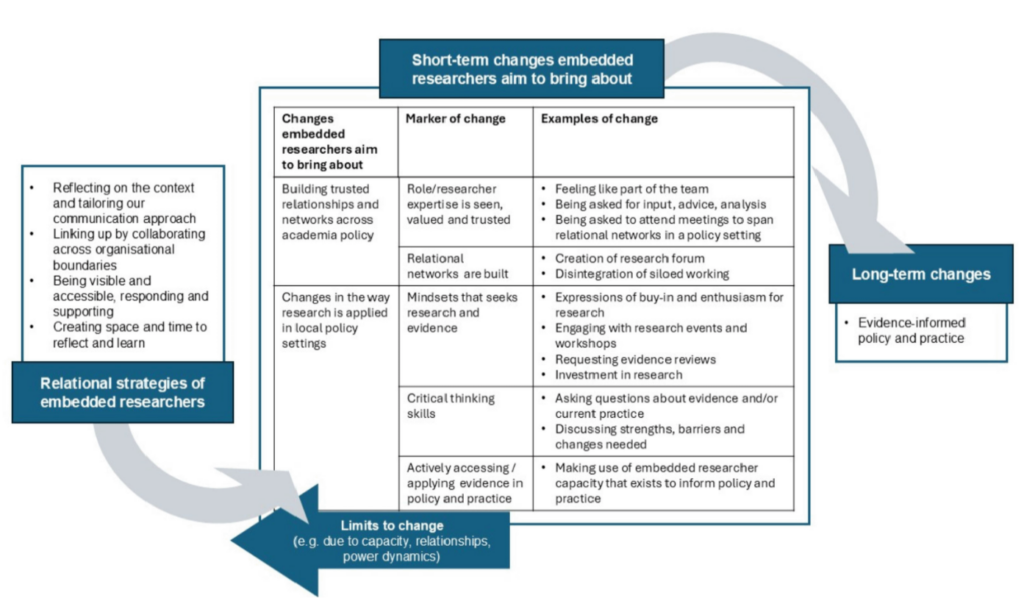
We identified four relational strategies that we, as embedded researchers, have used to help support evidence-informed practice:
- Tailor Communication: Adapt how information is shared to make sure it fits the local context and the specific needs of the team.
- Collaborate Across Boundaries: Help to connect different departments or external partners who might otherwise work in relatively separately.
- Be Visible and Accessible: Simply be “part of the team” (as much as is possible in your role) so that colleagues feel they can reach out for a quick chat or informal advice.
- Create Space for Reflection: Help busy practitioners find the time and space to step back and think critically about how different types of evidence might apply to their work.
Spotting “Short-Term” Signs of Progress
Measuring a final policy outcome can take months or years. However, we identified several “markers” that suggest the embedded researcher role is starting to have an impact on how evidence is viewed and used:
- Trust and Integration: A key marker is when a researcher is seen as a trusted colleague – for example, being asked to provide input on a project early on or being invited to attend strategic meetings.
- Changes in Mindset: Shifts in how teams approach their work, such as colleagues actively seeking out research or expressing a growing interest in how data can inform their decisions, can be a sign of change.
- Applying Evidence to Practice: This might involve more clear examples of a team using research to help shape a local service or using evidence to challenge and refine existing assumptions.
Why This Matters
We hope the framework provides a useful reference for local government teams and researchers. By identifying early markers of change, organisations can develop clearer expectations for embedded researcher roles, and embedded researchers can build more confidence in their day-to-day practices.
Ultimately, the framework will help us understand how embedded researchers can support change towards evidence-informed decision-making in local government, and the public health work that our colleagues are doing.
By:
Dr Amy Barnes, Deputy Director of the Born in Bradford Centre for Social Change at University of York and lead of Healthy Livelihoods Team, University of York
Dr Lisa Dowling, Senior Research Fellow within orn in Bradford’s Healthy Urban Places programme, Bradford Institute For Health Research
Access the policy brief:
Making evidence work: How “embedded researchers” can support decision-making in local government
Access the full paper:
Dowling L, Barnes A, Southall-Edwards R et al. The role of embedded public health researchers in local government: Identifying markers of changes in relationships and how evidence is applied in policy and practice, Wellcome Open Res 2026, 11:133 https://doi.org/10.12688/wellcomeopenres.25838.1